Youth Level of Service - Case Management Inventory (YLS-CMI)
SAC teaches classes on adopting and using the YLS-CMI actuarial risk assessment instrument for juvenile justice organizations. SAC staff are certified YLS-CMI trainers through Multi-Health Systems, Inc.
Project Director: Erica King
Dates: 2006 - 2008
Juvenile Recidivism Research
The measurement of the juvenile recidivism rate is a key outcome measure of the effectiveness of a juvenile justice system. This continuing project with the Maine Department of Corrections (MDOC) Juvenile Services Division measures and reports the recidivism rate of juveniles first adjudicated of a crime in Maine, provides a comparison among prior cohorts, and develops analytical tools to assist the juvenile justice system to address trends occurring in the data.
Project Directors: Erica King, George Shaler, Susan Pate
Dates: 1999 - Present
Juvenile Disproportionate Minority Contact (DMC)
With rapid increases in Maine's minority population concurrent with a federal change of standard from confinement to contact, Maine is now required to report data to determine the existence of disproportionate contact at multiple decision points in the juvenile justice system. The Maine Juvenile Justice Advisory Group (JJAG) is charged with ensuring that minority juveniles are not over represented in the juvenile justice system. The JJAG has hired the SAC to conduct phase I in DMC research – the identification phase. The SAC is developing a scheme to collect, analyze and report data on DMC in Maine and conducting a capacity assessment of the data collection systems and current practice of collecting DMC information.
Project Director: Carmen Dorsey
Dates: 2004 - Present
Juvenile Justice Law and Policy Internship
Clinical Professor Christopher Northrop, a nationally-recognized Maine juvenile defense attorney at the University of Maine School of Law, places a Juvenile Law & Policy intern with SAC each year. The intern provides policy research assistance to Maine’s Juvenile Disproportionate Minority Contact (DMC) project, under the guidance of the Mr. Northrop and SAC staff. Students have conducted qualitative and quantitative research, developed program materials, provided training and technical assistance, and presented key project findings to the Maine Juvenile Justice Advisory Group, which funds the project as mandated by the federal Office of Juvenile Justice and Delinquency Prevention.
Project Director: Carmen Dorsey
Dates: 2006 - Present
Juvenile Justice Task Force (JJTF)
In May, 2009, the Maine Juvenile Justice Task Force was convened with a charter issued by co-chairs the Chief Justice of Maine’s Supreme Court, Leigh Saufley, First Lady Karen Baldacci, and University of Maine School of Law Dean Peter Pitegoff. The Task Force, comprised of over 70 working professionals in the field of juvenile justice are meeting in plenary and in three subcommittees to formulate transformative recommendations. The system reform recommendations will suggest new funding strategies, mechanisms of collaboration, policy initiatives, and improved program components and assessment. The final recommendations will be presented at a 350-participant Summit on December 4, 2009. There, stakeholders from across the state will have the opportunity to meaningfully discuss and contribute to the recommendations before they are inserted into a preliminary Task Force Report in early 2010. The Summit will also feature workshops from leading contributors to the national juvenile justice stage. The Task Force Report will be disseminated in the spring of 2010 and featured in strategic planning for active reform.
Project Director: Michael Brennan
Dates: June 2009 - present
Continuous Quality Improvement (CQI)
SAC assists agencies to measure and monitor ongoing quality improvements in agency practices and services. SAC develops customer satisfaction surveys, peer review tools, outcome measures and program evaluation processes as part of a larger agency CQI framework.
Project Director: Erica King
Dates: 2006 - Present
Maine Juvenile Justice Advisory Group (JJAG) Technical Assistance & Evaluation Project
Juvenile Justice Advisory Group (JJAG) - The Maine JJAG awards grants to selected non-profits through the Office of Juvenile Justice & Delinquency Prevention (OJJDP) Formula Grant Program. SAC staff provides technical assistance, evaluation support and training to help the grantees increase their evaluation capacity. SAC trains grantees to develop their own logic models and provides technical assistance in the development of other evaluation tools.
Project Director: George Shaler
Dates: 2007 - present
Guardian Ad Litem
During the First Special Session of the 122nd Legislature, the Legislature enacted S.P. 474 – L.D. 1376 Chapter 101, Resolve, Directing the Department of Corrections to Establish a Pilot Project at the Department’s Juvenile Correctional Facilities. As stipulated in the resolve, a pilot project was established to determine the need of judicial review for the services provided to at-risk juveniles committed to a Maine Department of Corrections (MDOC) juvenile correction facility. SAC evaluated the pilot initiative.
Project Director: Susan Pate
Dates: 2006 - 2007
Juvenile Detention Study
The Maine Juvenile Justice Advisory Group (JJAG) directed an initiative to explore alternatives to secure detention with the goal of outlining strategies to reduce the use of secure detention in Maine. To support this goal, SAC studied pre-court juvenile detention practice in Maine by conducting a survey of juvenile justice professionals, analyzing Maine’s detention population at two points in time, and conducting a literature review to outline best practice and areas for further inquiry. The project, which produced a 1) Maine Juvenile Detention Briefing Paper and 2) Maine Juvenile Detention Data Report, was funded by the Maine Juvenile Justice Advisory Group.
Project Director: Al Sheehy, Carmen Dorsey, George Shaler
Dates: 2002 - 2003
Healthy Androscoggin
SAC provides guidance and assistance in conducting community assessments (including conducting focus groups, developing surveys, and analyzing data) as part of the Mobilizing for Action through Planning and Partnerships (MAPP) process.
Project Directors: George Shaler, Becky Noreus
Dates: 2007 - present
School Suspension/Expulsion Study
SAC examined the characteristics of Maine high school students suspended, expelled, or referred to alternative education using primary and secondary sources, and produced two reports: 1) Maine School Suspension/Expulsion Briefing Paper and 2) Maine School Suspension/Expulsion Data Report. This project was funded by the Maine Juvenile Justice Advisory Group.
Project Director: Al Sheehy, Carmen Dorsey, George Shaler
Dates: 2002 - 2003
Maine Crime Victimization Survey
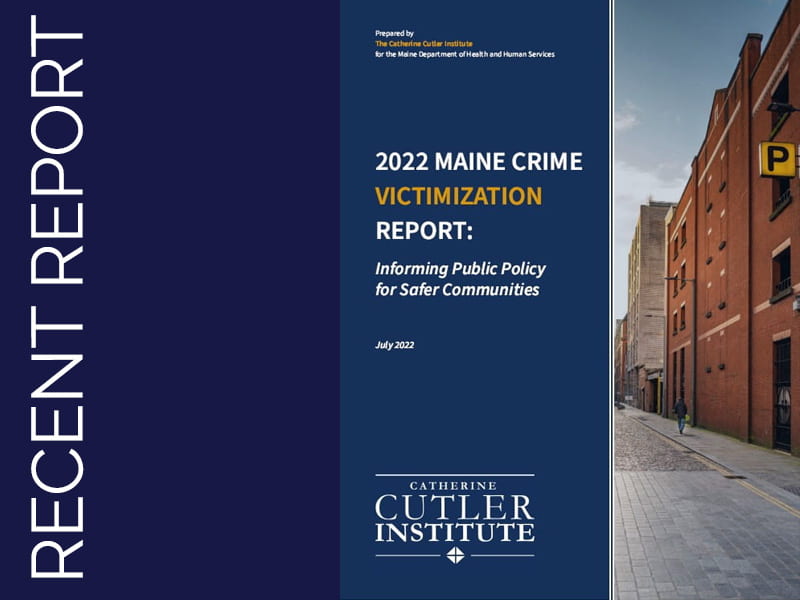
Until recently, Maine was not able to describe its state level crime victimization rates. With support from the Department of Justice, Bureau of Justice Statistics and a state advisory group, SAC initiated the first state crime victimization survey and in March, 2007 released the Maine Crime Victimization Report, Informing Public Policy for Safer Communities. An advisory group representing state and federal governmental agencies, non-profit groups, coalitions and commissions supported and guided development of the survey and production of the report. Findings on Mainers’ perceptions of safety and actual victimization rates are helping to provide information about public safety issues of critical importance to Maine. Specifically, the findings have been used to inform deliberations on various bills before the state legislature, in outreach materials about sexual assault and domestic violence, and in discussions about the scope and prevalence of certain types of victimization – e.g. stalking, identity theft – in Maine.
Project Directors: Carmen Dorsey, Mark Rubin, Allan Leighton
Dates: 2005 – 2007
Maine Crime & Justice Data Books and Brief Series
SAC’s Maine Statistical Analysis Center (SAC) plays a key role in the state by analyzing crime and justice system trends and information for the Maine legislature, governmental agencies, non-profits, students and other stakeholders interested in learning about and using Maine crime data. The SAC produces a data book every 2-3 years for this purpose. In alternating years, the SAC produces a series of research and policy briefs providing information about Maine’s police, courts and corrections data trends and implications for policy and practice. In 2009, the SAC will release a new data book with the latest updates.
Project Directors: Carmen Dorsey, Mark Rubin, George Shaler
Dates: 1999 - present
Girls' Data Project
The Girl Scouts of Kennebec Council collaborated with SAC to design, produce and disseminate a baseline report of national and state data related to girls’ strengths and needs in the areas of health, education, psychosocial and other social indicators. SAC identified, compiled and analyzed secondary data sources, reviewed the literature to place the data into context, and contributed written descriptive findings for inclusion into the final report, entitled Maine’s Future: A Report on the Status of Young Women in Maine.
Project Directors: Caroline Macdonald, George Shaler, Carmen Dorsey, Jennifer Long
Dates: 2001-2003
No Limits for Girls
The goals of this project, funded by the Maine Juvenile Justice Advisory Group, were to 1) increase middle and high school personnel’s awareness and knowledge of the needs of at-risk and adjudicated girls, and to 2) assist school staff to design and implement gender-responsive youth development programming within their schools. The No Limits for Girls final evaluation report is available on this website.
Project Directors: Kate Webb, Amy Detgen
Dates: 2002-2003
10th National Workshop on Adult and Juvenile Female Offenders: Charting a Course, Lighting the Way (2003)
Sponsored by the Maine Department of Corrections and the Association of Programs for Female Offenders, the conference, held in Portland, Maine, provided a national professional development forum for 550 researchers and practitioners working with adult and juvenile female offenders to discuss best practice and the latest research in the field. SAC contributed facilitation, coordination and research/technical assistance expertise to the development of the conference.
Project Directors: Carmen Dorsey, Caroline MacDonald, Polly Campbell
Dates: 2001 - 2003